
Selling Packaged Food Online: 10 Essential Seller Checks
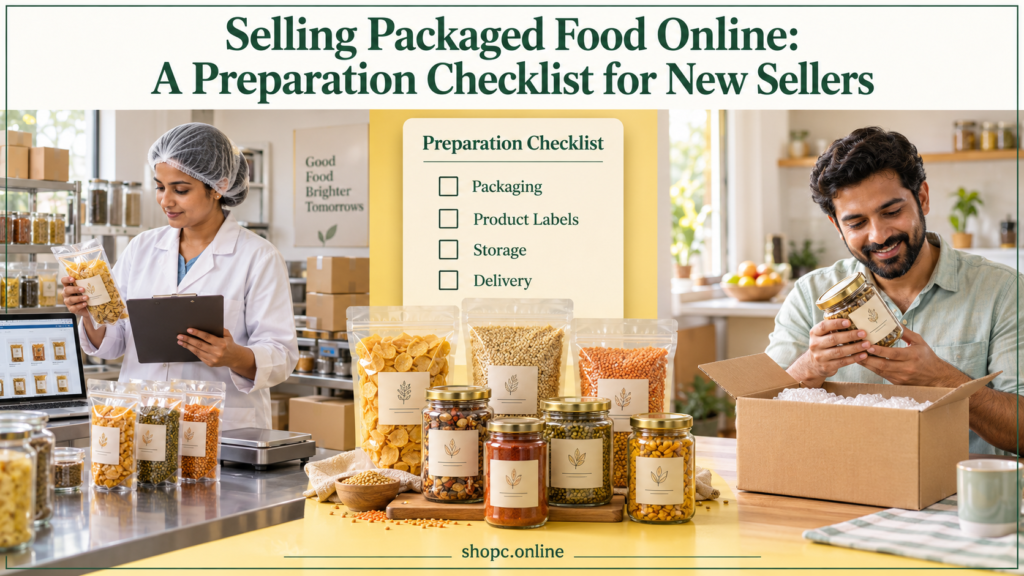
Selling Packaged Food Online: A Preparation Checklist for New Sellers
Selling packaged food online involves more than photographing a pouch and adding a price. A customer needs to understand what is inside, how much they will receive, how to store it and whether it suits their dietary requirements.
For a snacks business in Salem, a spice seller in Coimbatore or a packaged-food retailer in Chennai, good preparation connects the listing with the actual product and the way it is handled.
This guide helps new sellers prepare for ShopC while giving customers practical checks before ordering. It focuses on ordinary packaged foods; specialist products need additional review.
Use it as a preparation checklist, not a product-specific compliance certificate. Have the applicable licensing, labelling and safety requirements checked by a qualified food-safety professional before launch.
1. Define Your Role Before Selling Packaged Food Online
First, establish what your business actually does.
Do you manufacture food, buy sealed products for resale, repack bulk goods or sell products under your own brand? Record each activity and the premises involved.
A retailer reselling sealed packs has different operational responsibilities from someone preparing a recipe and packing it under a new label. Do not assume another business’s licence automatically covers your own activities.
Use the official FoSCoS portal to check the appropriate registration or licensing route. FSSAI introduced revised turnover thresholds in 2026, so older online guides may give outdated figures.
The current kind-of-business eligibility guidance is a useful starting point. A marketplace operator and an individual seller are not automatically the same licensing category; confirm the classification that applies to you.
Before buying packaging in bulk, make sure your activity, premises and proposed products have been reviewed correctly.
2. Confirm That Your Products Fit the Delivery Arrangement
Start with a range you can store, pack and deliver reliably.
Group products by their actual requirements:
| Product type | Preparation question |
|---|---|
| Ambient products | Are they verified as suitable for the expected storage and transport conditions? |
| Refrigerated products | Can the required temperature be maintained throughout the journey? |
| Frozen products | Is an appropriate frozen-storage and delivery arrangement available? |
| Fragile or liquid products | Have breakage, leakage and outer-pack protection been assessed? |
| Products with a short shelf life | Can customers receive them within the applicable delivery and shelf-life limits? |
A sealed container does not automatically make food shelf-stable. Nor does a nearby customer remove the need for suitable handling.
Do not assume ShopC provides refrigerated delivery because it offers local delivery. Confirm the actual service for your product, location and route before accepting an order.
If the required conditions cannot be maintained, keep that item unavailable until a suitable arrangement is established.
3. Prepare a Product Record for Every Pack Size
Keep a single, checked record from which your label and listing information can be prepared.
Include the product identity, manufacturer or supplier, formulation version where relevant, pack size, storage requirements, approved label artwork and supporting product information.
For retailers, retain supplier invoices and obtain readable, current label information. For manufacturers, keep the formulation and production records needed to support what you sell.
Treat different pack sizes and flavours as separate variants. A 200 g pouch and a 500 g pouch should not accidentally share the wrong price or photograph.
Assign a stock code to each variant. Record batch information separately, since several batches may belong to the same product code.
This makes it easier to update a listing, answer a customer question or identify affected stock when a problem arises.
4. Review the Physical Label and Online Disclosures
Check the applicable FSSAI labelling regulations and amendments, together with relevant packaged-commodity requirements.
Your label review should cover, as applicable:
- Food name, ingredients and nutrition information.
- Allergen declaration and vegetarian/non-vegetarian marking.
- Net quantity, MRP and consumer-care information.
- Business identities, addresses and FSSAI particulars.
- Batch identification, manufacture/packing and expiry/use-by dates.
- Storage conditions, preparation instructions and product-specific declarations.
This is a review list, not an exhaustive label template; exemptions and category-specific rules can apply.
Mandatory label information generally needs to be available before an online purchase. FSSAI’s labelling rules provide specific pre-sale exceptions for batch and date fields; these do not remove applicable physical-pack requirements.
Do not confuse best-before information with expiry/use-by. Have the correct date-marking approach checked for your product.
Tamil explanations can help local customers. Mandatory label declarations must still meet the applicable language requirements; Tamil can supplement the required English or Hindi information.
5. Make Allergen Information Easy to Read
Show the verified allergen declaration clearly. Distinguish ingredients intentionally present from possible cross-contact.
Do not substitute “may contain” for a required “contains” declaration or guess an allergen-free claim. Match the listing to the checked label.
From a customer’s perspective, this information should be easy to locate without enlarging a blurred photograph.
When a recipe, supplier or ingredient changes, review the affected information before sending the changed product. Do not assume an existing customer can safely accept a replacement flavour or formulation.
If a buyer asks a question you cannot answer from verified product information, investigate before recommending the item. A confident guess is not useful customer service.
6. Establish Shelf Life and a Dispatch Cut-Off
If you manufacture or repack food, arrange product-appropriate assessment of shelf life, packaging and storage conditions with competent technical support. Do not copy a competitor’s expiry period or rely only on taste and appearance.
If you resell sealed products, follow the manufacturer’s verified information and do not alter dates.
Separate three concepts in your records:
| Term | Meaning for your operation |
|---|---|
| Total shelf life | The established period for the unopened product under specified conditions |
| Remaining shelf life | The time left when the customer receives the particular batch |
| After-opening instructions | The handling and use guidance once the seal is opened |
FSSAI’s e-commerce food advisory addresses remaining shelf life at delivery. Confirm the current requirement and its application to your product before setting a dispatch cut-off; do not assume any unexpired pack is suitable to send.
Allow for transit and realistic delays. Use first-expiry-first-out stock rotation, while excluding stock that no longer meets dispatch criteria.
For example, an illustrative batch with 20 days remaining at dispatch would have only 15 days after a five-day journey. That calculation alone does not establish whether delivery is compliant or suitable.
7. Choose Suitable Packaging and Handling Controls
Select food-contact packaging appropriate for the specific food, process and storage conditions. Obtain relevant specifications from your packaging supplier rather than choosing only by appearance.
Assess the seal, leakage risk, moisture protection, breakage and label durability. An attractive outer box cannot correct an unsuitable inner container.
Keep food away from cleaning products and other contamination sources. FSSAI’s e-commerce advisory requires separate delivery of food and non-food items to avoid cross-contamination.
For products needing temperature control, document how that control will be maintained and what happens after a delay or failed delivery. An insulated bag alone is not evidence that the required conditions have been maintained.
Staff should know where approved stock is stored and where damaged, returned or held stock belongs. Make these locations clearly distinguishable so a pack on hold cannot be picked accidentally.
8. Build a Clear, Accurate Food Listing
A useful title identifies the food and quantity:
Brand + food name + flavour or variant + net quantity
For example, “Example Brand Roasted Peanut Snack — 200 g” is a fictional title structure, not a verified ShopC product.
Add readable photographs of the front and relevant label panels. Show the actual pack size, and label serving suggestions so bowls, ingredients or props are not mistaken for package contents.
Explain whether the product is ready to eat or needs preparation. Use checked instructions rather than inventing a recipe or serving method.
Keep online claims aligned with the physical label and properly substantiated, as FSSAI’s e-commerce advisory requires. Do not add disease-treatment promises or unsupported claims such as “sugar-free,” “organic” or “high protein” simply to attract searches.
When selling packaged food online, useful information builds trust more effectively than repeating “healthy food” throughout the description.
9. Calculate Prices and Set Customer Expectations
Review the cost of the product, compliant packaging, order handling, applicable platform charges, delivery and expected wastage.
Confirm tax treatment and pricing obligations for your circumstances with a qualified adviser. Do not assume all packaged foods receive the same treatment.
For customers, show the selected pack size, quantity and payable price clearly. A photograph showing three pouches should not imply that three are included when the price is for one.
Before joining, use the ShopC vendor registration page and ask the team to confirm food-category requirements, seller charges, payout terms and delivery responsibilities.
ShopC’s shipping policy states that service availability depends on the customer’s pincode and the vendor’s delivery radius. Confirm what applies to your orders rather than promising a single delivery time for every location.
10. Prepare for Complaints, Holds and Recalls
Decide how your team will handle a leaking pack, wrong item, suspected spoilage or an allergen-information error.
Keep a practical incident record: order number, product, batch, complaint, photographs where available, action taken and person responsible.
If a food-safety concern arises, hold potentially affected stock and seek appropriate technical and regulatory guidance. Preserve the records needed to identify other affected orders and carry out withdrawal or recall actions where required.
Do not tell a customer to taste suspicious food to check it. Do not automatically return food to sale after it has been outside your control.
ShopC’s returns and refunds policy explains that eligibility varies by product and vendor. A restricted change-of-mind return policy should not be presented as a reason to ignore damaged, incorrect or potentially unsafe food.
Direct customers to the ShopC contact page for platform assistance.
Final Preparation Checklist for New Sellers
Use this as an operational sign-off sheet. A tick means you have checked the evidence, not simply discussed the task.
| Check | Ready when |
|---|---|
| Business classification | The relevant activities, premises and licensing route are confirmed |
| Marketplace onboarding | ShopC’s food-seller requirements and terms are understood |
| Product information | Current supplier or manufacturing records are available |
| Label review | Applicable declarations and claims have been checked |
| Online listing | Pack size, photos and pre-sale information are accurate |
| Allergen information | The declaration matches the verified product |
| Shelf-life control | Dates, remaining-life criteria and dispatch cut-offs are established |
| Packaging | Materials and protection suit the food and delivery conditions |
| Storage and transport | Required conditions can be maintained |
| Stock control | Batches, expiry dates and stock holds are identifiable |
| Customer support | Complaints and incidents have a clear handling process |
| Trial order | A trial has checked picking, packing, handover and information accuracy |
A trial order helps reveal operational problems. It does not replace shelf-life validation, laboratory work or other required checks.
What Customers Should Check Before Ordering Packaged Food
Read the Ingredients and Allergen Information
Review the information for the exact variant. A different flavour or pack version may have a different formulation.
If you have a known food allergy and the information is unclear, ask for verified details before purchasing. Do not rely on a product name or a “homemade” description.
Confirm Quantity and Preparation
Check net quantity, the number of packs and whether the food needs cooking or other preparation. Compare similar quantities when assessing value.
Check Storage Requirements
Make sure you can store the product as directed when it arrives. For temperature-sensitive food, clarify the delivery arrangement before ordering.
Inspect the Delivered Pack
Check the seal, pack condition, label and applicable dates. Follow the storage instructions promptly.
Do not consume food with a compromised seal, unexplained swelling, leakage or suspected spoilage. Contact support and retain the order details and batch information.
Ask About Missing Information
Before ordering, clarify anything that affects your decision. Sellers should welcome specific questions because they reveal where a listing needs improvement.
A Simple Product-Page Structure
Use the following order when assembling your listing:
- Product name and net quantity.
- Clear pack photographs.
- Short factual description.
- Verified ingredients and allergen information.
- Applicable nutrition and dietary marking information.
- Storage and preparation instructions.
- Relevant business and FSSAI particulars.
- Price, pack count and availability.
- Delivery information and customer-support link.
This is a content structure, not a compliant label specimen. Add all other applicable disclosures after product-specific review.
Keep an internal version number for approved listing content. When packaging or formulation changes, update the product page and photographs together.
Frequently Asked Questions
Can a Home-Based Business Sell Packaged Food Online?
A home address is not a blanket exemption from food-business requirements. Confirm the relevant activities, premises and registration or licensing route through FoSCoS before applying to a marketplace.
Is ShopC Registration the Same as FSSAI Registration?
No. Marketplace onboarding and food-business registration or licensing are separate. Confirm and complete the requirements that apply to your business.
Can I Choose a Shelf Life Similar to Another Seller’s Product?
No. A similar name or recipe does not establish the same shelf life. Manufacturers and repackers need appropriate technical assessment; retailers should follow verified manufacturer information.
Does Every Packaged Food Need Refrigeration?
No. Follow the product’s established storage requirements. Sealed packaging alone does not prove that a food can be kept at room temperature.
Can I Put All Food Information Only in a Photograph?
Do not assume a small label image is sufficient. Make required pre-sale information clearly accessible and keep readable photographs as supporting information.
Does a Non-Returnable Food Policy Remove the Need to Handle Complaints?
No. Sellers still need a process for incorrect deliveries, damage and potential food-safety issues. Review the platform’s policy and applicable obligations.
Start with Products You Can Handle Reliably
Selling packaged food online works best when the listing, label, stock records and delivery process agree.
Begin with a manageable range, complete the necessary reviews and make important information easy for customers to find.
For sellers: Review ShopC’s vendor registration requirements and confirm the arrangements for your food category.
For customers: Visit ShopC, read the product details and check storage and delivery requirements before ordering.
More from the blog

Sell Home Décor Online: 10 Smart Listing Tips
Sell home décor online with clear photos, accurate dimensions and helpful product details. A practic…
View more →
How to Sell Clothing Online: 10 Smart Listing Tips
Learn how to sell clothing online with accurate size charts, clear photos and useful product details…
View more →
How to Sell Handmade Jewellery Online: 10 Easy Steps
Learn how to sell handmade jewellery online with practical tips on pricing, photos, product descript…
View more →