
How to Identify Pure Silk Saree: Simple Checks Before You Buy
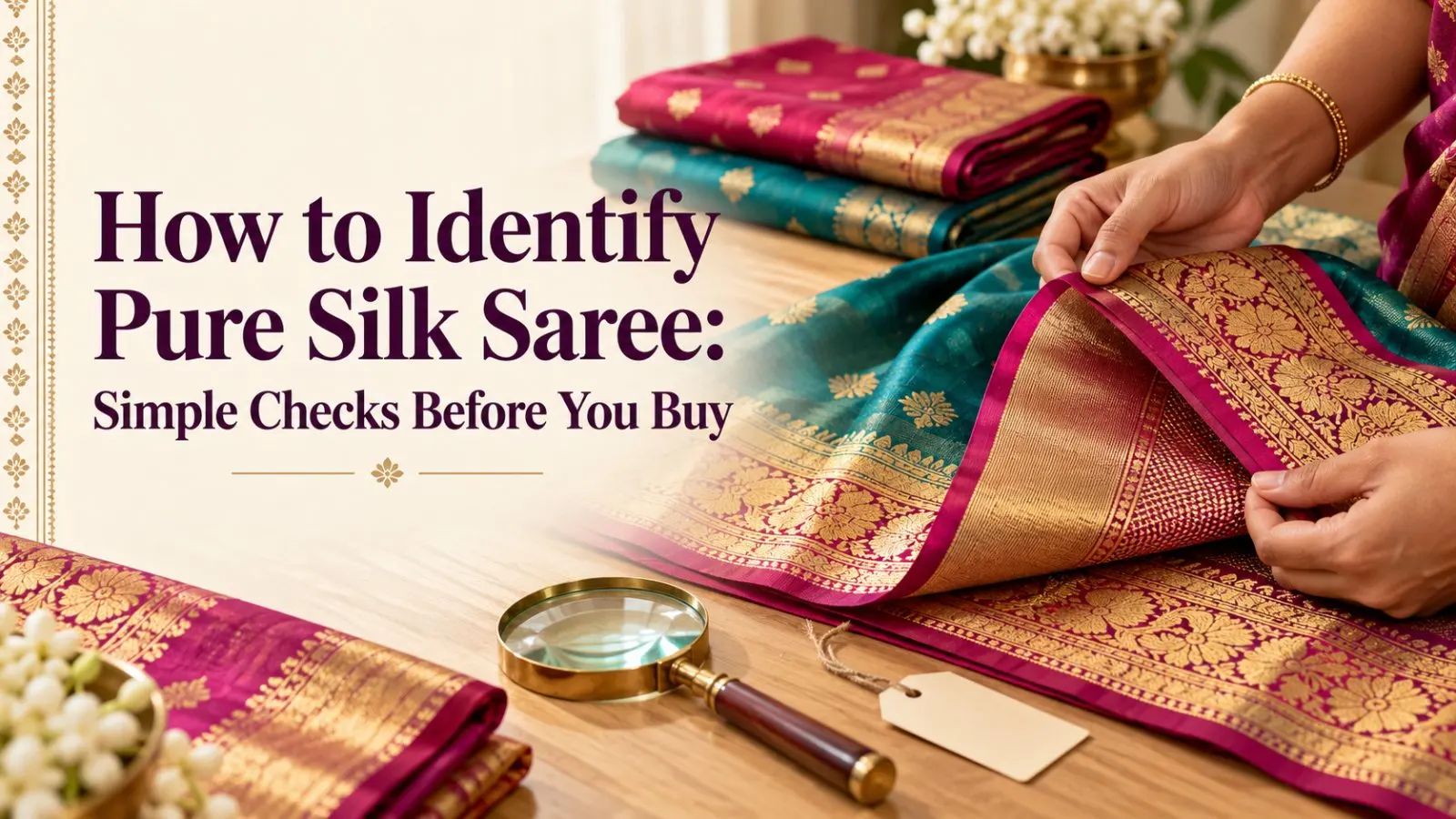
A silk saree is often the most expensive piece in a wardrobe, and many are bought for weddings, festivals or as gifts that will be kept for years. So it hurts to find out later that the “pure silk” saree was a blend. Learning how to identify pure silk saree takes only a few minutes, and the simple checks below can help you buy with more confidence, both in a shop and online.
No single test is perfect. Use two or three together, and when in doubt, ask the seller for proof.
Table of Contents
Why it matters
Pure silk is made from natural fibres spun by silkworms. It breathes well, drapes beautifully and lasts for decades with care. Art silk, polyester and blends can look similar, especially in photos, but they feel different, age differently and should cost much less. Knowing the difference protects your money and helps you choose the right saree for the occasion.
How to identify pure silk saree: 8 tests
1. Feel the fabric
Pure silk feels smooth and soft but has a slight grip, not a slippery, plastic feel. When you rub it between your fingers, it warms up quickly. Synthetic fabric often stays cool and feels too slick.
2. Watch the sheen
Turn the fabric in the light. Pure silk shows a soft, changing shine, and the colour can look slightly different from each angle. Polyester tends to have a flat, uniform shine that looks the same from every side.
3. The crush test
Hold a part of the pallu in your fist for a few seconds and release it. Pure silk creases a little but the wrinkles soften quickly. Very stiff fabric that springs back without any crease may be synthetic.
4. The ring test
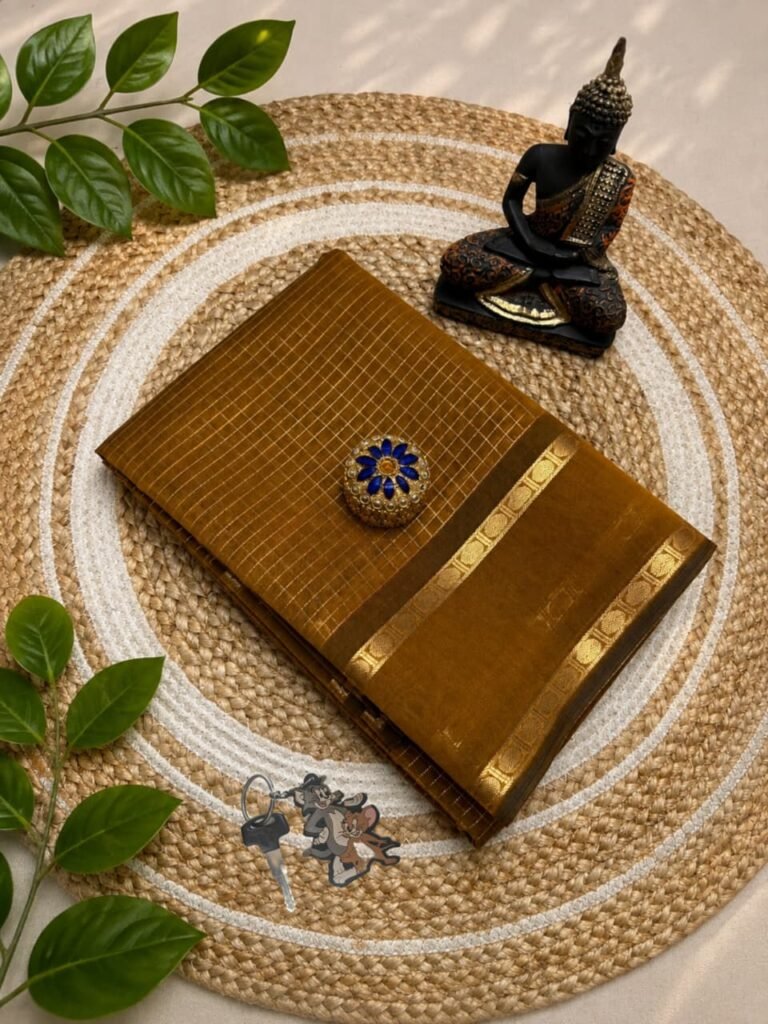
Traditional sellers sometimes pull a light silk saree through a finger ring to show its fineness. This works only for thin silks. Heavy Kanchipuram sarees with thick zari will not pass through a ring even when they are pure, so do not rely on this test alone.
5. The burn test (only on a loose thread)
Ask the seller for a loose thread from the edge, never burn the saree itself. Real silk burns slowly, smells like burnt hair and leaves a soft ash that crushes to powder. Polyester melts, smells like plastic and forms a hard bead. Do this carefully over a steel plate.
6. Check the zari
Pure zari is made of silver thread coated with gold. “Tested” zari uses a copper core instead, so if a scratch at the back of the border shows a reddish colour, it is tested zari. Tested zari is common and perfectly wearable, but it should cost less than pure zari. Ask the seller what type of zari is used.
7. Look for the Silk Mark label
The Silk Mark is a quality label promoted by the Silk Mark Organisation of India for pure silk products. A tag with a Silk Mark and a unique number is a strong sign of genuine silk. You can read more on the Silk Mark Organisation of India website.
8. Compare the price and weight
A pure silk saree with rich zari cannot be very cheap. If the price seems too good to be true, it usually is. Pure silk sarees with heavy borders also feel noticeably heavier than art silk.
Pure silk vs art silk at a glance
| Check | Pure silk | Art silk / polyester |
|---|---|---|
| Feel | Soft with slight grip, warms up | Slippery, stays cool |
| Sheen | Changes with the angle | Flat, uniform shine |
| Burn test | Burnt-hair smell, powdery ash | Plastic smell, hard bead |
| Price | Higher | Much lower |
| Label | Often Silk Mark tagged | No Silk Mark |
Buying a silk saree online
Online, you cannot touch the fabric, so ask more questions:
- Read the fabric line in the description. “Soft silk” or “art silk” is different from “pure silk”.
- Ask the seller for close-up photos of the weave, border and zari in daylight.
- Check whether a Silk Mark tag or a written purity guarantee is provided.
- Read the return policy before ordering.
On ShopC, you can browse sarees and ethnic wear from Tamil Nadu boutiques and message the seller about fabric details before you buy. Our Shopping Guide explains how ordering works step by step.
Caring for your silk saree
- Dry clean for the first few washes, or hand wash gently in cold water with a mild shampoo.
- Dry in shade, never in strong sun.
- Fold with a soft cotton cloth and refold every few months to avoid permanent creases.
- Keep away from naphthalene balls touching the zari.
Common myths about silk sarees
“Real silk never creases.” Pure silk does crease a little; it simply recovers faster than many synthetics.
“Heavy means pure.” Weight can come from thick zari or a heavy synthetic yarn too. Combine weight with other checks.
“A shiny saree is always silk.” Polyester can be very shiny. The kind of shine matters more than the amount.
Questions to ask the seller
- Is this pure silk, a blend or art silk?
- Is it handloom or power loom?
- Is the zari pure, tested or imitation?
- Does it have a Silk Mark tag?
- What is the return policy if the fabric is not as described?
A seller who answers clearly and in writing is usually confident about the product. Knowing how to identify pure silk saree quality, together with these questions, gives you the best chance of buying the saree you are paying for.
Which silk saree test should you trust most?
No single silk saree test is foolproof. The Silk Mark label and a burn test on a loose thread are the most reliable, followed by feel and sheen. When a pure silk saree is a big purchase, combine at least three checks and keep the bill and the seller’s written description. If a pure silk saree later turns out to be a blend, these documents help you ask for a return.
Frequently asked questions
Use these checks together, ask honest questions, and you will know how to identify pure silk saree with confidence the next time you shop.
What is the easiest way to identify a pure silk saree?
Feel the fabric, check the changing sheen and look for a Silk Mark tag. Use a burn test on a loose thread if the seller allows it.
Does pure silk pass the ring test?
Thin silks may pass through a ring, but heavy Kanchipuram sarees with thick zari will not, even when they are pure.
What does real silk smell like when burnt?
Real silk smells like burnt hair and leaves a soft ash that crushes to powder.
More from the blog
Cotton Saree Care in Monsoon: Wash, Dry and Store the Right Way
Simple cotton saree care tips for the rainy season: gentle washing, how to dry cotton sarees indoors…
View more →
Protect Phone in Rain: Simple Monsoon Phone Care Tips at Home
Learn how to protect phone in rain with a mobile rain cover, simple monsoon phone care habits, wet p…
View more →
Herbal Tea for Rainy Days: Warm Drinks for Monsoon Evenings
Herbal tea for rainy days: how to brew hibiscus tea, blue pea tea and sukku malli coffee at home, wi…
View more →